How Do You Decide Between Tube And Solid State Amplification For Reference Speakers?
The choice is less about romance versus precision than about the loudspeaker load, your listening habits, and how much involvement you want from ownership. Here is a clear-eyed comparison.
What each technology actually does differently
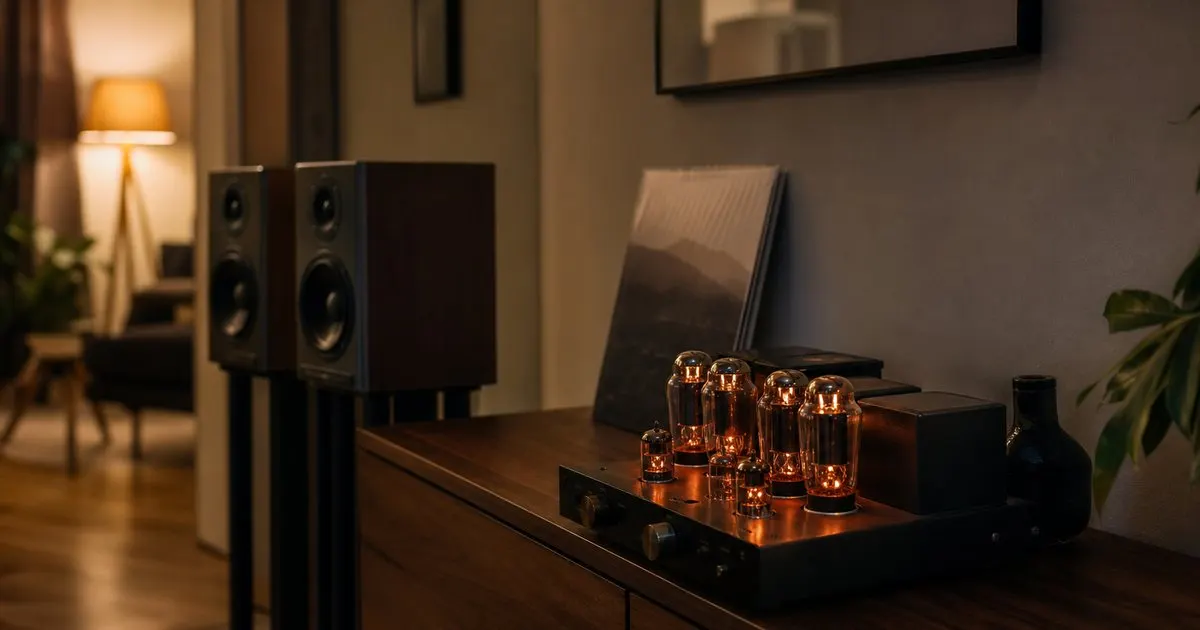
A tube amplifier with output transformers presents a relatively high output impedance to the loudspeaker, and that impedance interacts with the speaker's own impedance curve. The practical result is a frequency response that follows the impedance curve to some degree, adding fullness where the impedance rises and thinning slightly where it dips. Tube designs also tend to overload gradually, producing distortion dominated by lower-order harmonics that the ear tolerates well, and they usually deliver fewer watts per dollar. Solid state offers low output impedance, high current delivery, more power for the money, and a neutral response regardless of the load, but when it clips, it clips abruptly and unpleasantly.
Neither approach is inherently more accurate in a way that reliably predicts which you will prefer in your room. The real variables are how well the amplifier's characteristics suit the loudspeaker and how good the specific design is. Hybrid amplifiers, which pair a tube input or driver stage with a solid state output stage, attempt to capture some of the tonal character of tubes while keeping the drive and stability of transistors. They are a legitimate category rather than a compromise, and some of the most satisfying reference amplifiers at 5,000 to 15,000 USD are built this way. Related: Why Does The Listening Room Shape Your Sound More Than Expected?
Keep reading: How Do You Build A Reference Hi-Fi System Without Wasting Money?, What Makes Loudspeakers And Amplifiers Truly Match In A Real Room?, Which Component Deserves The Largest Share Of Your Hi-Fi Budget?. See how Sonoholm helps you an audiophile guide to reference loudspeakers and hi-fi.
Let the loudspeaker decide most of the question
Loudspeakers with high sensitivity and a benign, relatively flat impedance, including many horn-loaded designs, some paper-cone designs, and certain wide-bandwidth single-driver speakers, are natural partners for lower-powered tube amplifiers, including single-ended designs producing only a handful of watts. On such speakers, a small tube amplifier can deliver a directness and a midrange presence that larger amplifiers struggle to match. Low sensitivity, low impedance, multi-driver reference loudspeakers with complex crossovers pull hard in the other direction. They typically need solid state power, or high-power push-pull tube amplifiers with properly matched 4 ohm output taps. Related: What Makes Loudspeakers And Amplifiers Truly Match In A Real Room?
Ask the loudspeaker manufacturer directly. Many will state what type of amplification the design was voiced with, and some will name a minimum power and a preferred output impedance. Then audition both types at the dealer on the exact loudspeaker you are considering, with levels matched, using your own recordings. An hour of that comparison teaches more than a month of reading forum opinions, because the interaction between amplifier output impedance and a specific speaker's load cannot be predicted from reviews of either component alone.
Ownership: heat, maintenance, and cost per year
Tubes wear. Output tubes commonly need replacement after some thousands of hours, depending on type, bias, and how hard they are run, while small-signal tubes last considerably longer. A re-tube of a large amplifier is a real recurring expense to budget for, and many designs require the bias to be checked and adjusted periodically, though auto-bias circuits remove most of that chore. Heat output is significant; a large tube amplifier in a small room in summer is noticeable on the thermostat, and the amplifier needs warm-up time before it sounds its best each session. Related: Can A Compact System Ever Sound As Good As A Large One?
Solid state amplifiers are essentially maintenance-free for a decade or more, though electrolytic capacitors eventually age and pure class A designs run nearly as hot as tubes. The honest question to ask yourself is whether the ritual of tube ownership, the glow, the warm-up, the occasional re-tube, the tinkering, is a pleasure or a chore. Both answers are legitimate. Listeners who enjoy the involvement tend to keep tube amplifiers for decades; listeners who want to press one button and forget about the equipment usually regret buying tubes within a couple of years.
A practical decision framework
Lean toward tubes when your loudspeakers are sensitive and easy to drive, when you listen mostly at moderate levels, when you value midrange texture and a sense of tonal density above the last degree of bass control, and when you are willing to maintain the amplifier. Lean toward solid state when the loudspeakers are demanding, the room is large, you play dynamic music loud, you want set-and-forget reliability, or you already run a subwoofer with a high-pass filter and want maximum grip on the mains. A tube preamplifier feeding a solid state power amplifier is a common and sensible middle path that adds some tube character while keeping the drive.
Whichever direction you choose, buy from a maker with a service network and a parts supply, because output transformers and output devices should remain repairable for decades, and a well-known design holds resale value far better than an obscure one. If you are torn, remember that the amplifier is the component most easily changed later without disturbing the rest of a reference system. Choose the loudspeakers you love first, match the amplifier to them, and accept that your preference may shift as your room and your listening habits change over the years. Related: How Do You Build A Reference Hi-Fi System Without Wasting Money?
- Tube amplifiers interact with the loudspeaker's impedance curve and clip gently; solid state stays neutral into any load and clips hard.
- Sensitive, easy-load speakers suit tubes; demanding multi-driver reference designs generally need solid state or high-power push-pull tubes.
- Budget for re-tubing, heat, and warm-up with tubes, and decide honestly whether that involvement is a pleasure or a chore.
- A tube preamplifier with a solid state power amplifier is a legitimate middle path, and the amplifier is the easiest piece to change later.

Julien Jimenez
Julien Jimenez is an independent software builder based in Paris. He designs, ships, and operates focused SaaS products for small businesses and independent professionals. Read the full author page.
Music As The Artist Intended
An audiophile guide to reference loudspeakers and hi-fi. Sonoholm is built to help you put this into practice.
Build your systemMore from the Sonoholm blog
How Do You Build A Reference Hi-Fi System Without Wasting Money?
What Makes Loudspeakers And Amplifiers Truly Match In A Real Room?
Which Component Deserves The Largest Share Of Your Hi-Fi Budget?
Get the complete reference hi-fi audio guide
Our full buying guide, the price guide, and new research as we publish it. One email, no spam, unsubscribe any time.