When Should You Service An Aging Reference Amplifier Instead Of Replacing It?
A well-built amplifier can run for decades, but capacitors, relays, and switches do wear out. Knowing the symptoms and the economics makes the choice between restoration and replacement much clearer.
How amplifiers age and what the symptoms sound like
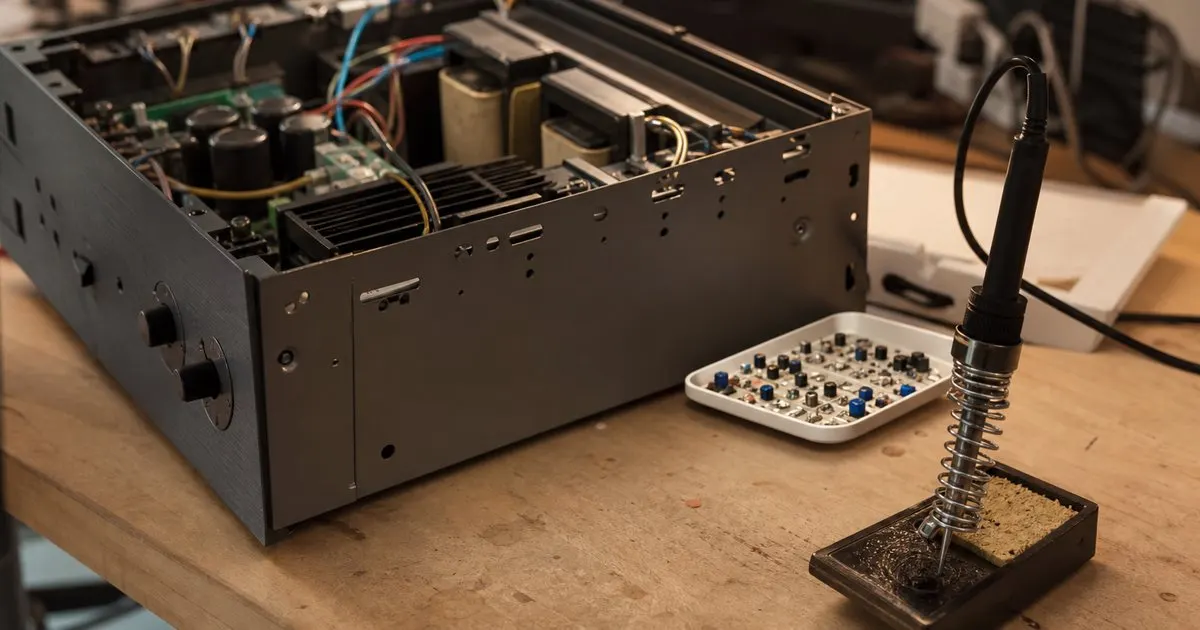
Electrolytic capacitors are the components that age most predictably. They dry out gradually over a couple of decades, faster in a hot chassis, and as they lose capacity the symptoms creep in: a low hum that was not there before, a softening of the bass, a slow or thumping turn-on, and in the power supply a loss of dynamic punch that owners often misattribute to their own hearing or to the loudspeakers. Mechanical parts age too. Relays and selector switches oxidize and produce crackle or a channel that drops out and returns when a knob is wiggled, volume potentiometers become scratchy, and solder joints near hot components eventually crack.
Some symptoms call for immediate action rather than a leisurely decision. One channel running noticeably hotter than the other, a measurable DC voltage at the loudspeaker terminals, which can destroy a woofer, a burning smell, a protection circuit that trips at ordinary volume, or a bias that has drifted so far that the output devices run hot at idle all mean the amplifier should be switched off and inspected before it is used again. An amplifier that fails under load can take a pair of reference loudspeakers with it, and that changes the economics of waiting.
Keep reading: How Do You Build A Reference Hi-Fi System Without Wasting Money?, What Makes Loudspeakers And Amplifiers Truly Match In A Real Room?, Which Component Deserves The Largest Share Of Your Hi-Fi Budget?. See how Sonoholm helps you an audiophile guide to reference loudspeakers and hi-fi.
What a proper service involves and what it costs relative to the amplifier
A competent technician will inspect the chassis, measure bias and DC offset, clean and treat switch and relay contacts, replace failing electrolytic capacitors, and test the output devices. A full recap, in which every electrolytic capacitor is replaced regardless of condition, is more extensive and more expensive than a targeted repair, and it is the right choice for an amplifier you intend to keep for another decade. Costs vary with the complexity of the design and the region, but a routine service is typically a small fraction of the amplifier's original price, while a comprehensive restoration of a large power amplifier can be a substantial sum. Always ask for a written estimate and ask for the replaced parts to be returned to you. Related: Why Does The Listening Room Shape Your Sound More Than Expected?
Use the manufacturer's own service department or an authorized shop when one exists, because they have the schematics, the correct parts, and the experience with that model. For an amplifier from a maker that has closed, find a technician with documented experience in that specific design. Be wary of offers to upgrade rather than repair. Substituting parts of different values or characteristics changes the sound in ways that nobody can predict, and the amplifier you liked may come back as a different amplifier. Ask for like-for-like replacement with equal or better quality parts of the same values.
When restoring is the right decision
Restore when the amplifier was built to a standard that the same money cannot buy today, which describes a great many designs from makers who used large transformers, heavy chassis, and generous discrete output stages. Restore when the manufacturer still supplies parts, when the sound is something you love and could not easily replace, when the resale value after restoration comfortably exceeds the cost of the work, or when a comparable modern amplifier would cost several times more. Well-known reference amplifiers from established makers frequently meet all of those conditions at once. Related: How Do You Build A Reference Hi-Fi System Without Wasting Money?
Consider the rest of the system as well. If your loudspeakers and preamplifier were chosen around this amplifier, replacing it reopens every matching question in the chain and can start a cascade of changes. A serviced amplifier with a documented history from a reputable shop is also a far better proposition on the used market than one with no records, so the money spent on a proper service is partly recovered at sale time. Keep every invoice with the unit. Related: What Makes Loudspeakers And Amplifiers Truly Match In A Real Room?
When replacing makes more sense
Replace when the amplifier has features you no longer use or lacks ones you now need, such as balanced inputs, a home theater bypass, or a trigger input, when the service history shows repeated failures that suggest a deeper design or heat problem, when critical parts are no longer available, when the restoration estimate approaches the price of a comparable modern amplifier, or when new loudspeakers require more power or a different topology than the old amplifier can provide. Modern designs also bring conveniences that matter in daily life: standby modes, sophisticated protection circuits, and quieter operation.
If you do replace it, sell the old unit with full disclosure of its condition and history, because the market for well-regarded older amplifiers is active and honest sellers are rewarded. Some listeners choose a third path and keep the old amplifier serviced as a backup or as the heart of a second system in a study or bedroom, which sidesteps the decision entirely while keeping a loved piece in use. Whatever you decide, the amplifier is the part of a reference system most likely to reward proper care, and the least likely to be improved by simply being newer. Related: Should You Buy Separate Components Or A Single Integrated Amplifier First?
- Aging capacitors, oxidized contacts, and drifting bias produce hum, soft bass, crackle, and lost dynamics that owners often misattribute to other components.
- DC at the speaker terminals, uneven heat, or a tripping protection circuit means switch off and inspect before the amplifier damages the loudspeakers.
- Restore when the build quality, parts availability, and sound justify it and the estimate sits well below a comparable modern amplifier.
- Replace when repairs recur, parts are gone, the feature set no longer fits, or new loudspeakers demand different amplification.

Julien Jimenez
Julien Jimenez is an independent software builder based in Paris. He designs, ships, and operates focused SaaS products for small businesses and independent professionals. Read the full author page.
Music As The Artist Intended
An audiophile guide to reference loudspeakers and hi-fi. Sonoholm is built to help you put this into practice.
Build your systemMore from the Sonoholm blog
How Do You Build A Reference Hi-Fi System Without Wasting Money?
What Makes Loudspeakers And Amplifiers Truly Match In A Real Room?
Which Component Deserves The Largest Share Of Your Hi-Fi Budget?
Get the complete reference hi-fi audio guide
Our full buying guide, the price guide, and new research as we publish it. One email, no spam, unsubscribe any time.