What Makes Loudspeakers And Amplifiers Truly Match In A Real Room?
The interplay of power, sensitivity, and character that decides whether a pairing sings.
A true match balances the amplifier's power against the speaker's sensitivity and stays stable with its impedance, so the pairing is neither underdriven nor strained. Tonal characters should complement rather than compound, and the room completes the equation. Judged together in your own space, a well matched pair sounds like music, not equipment.
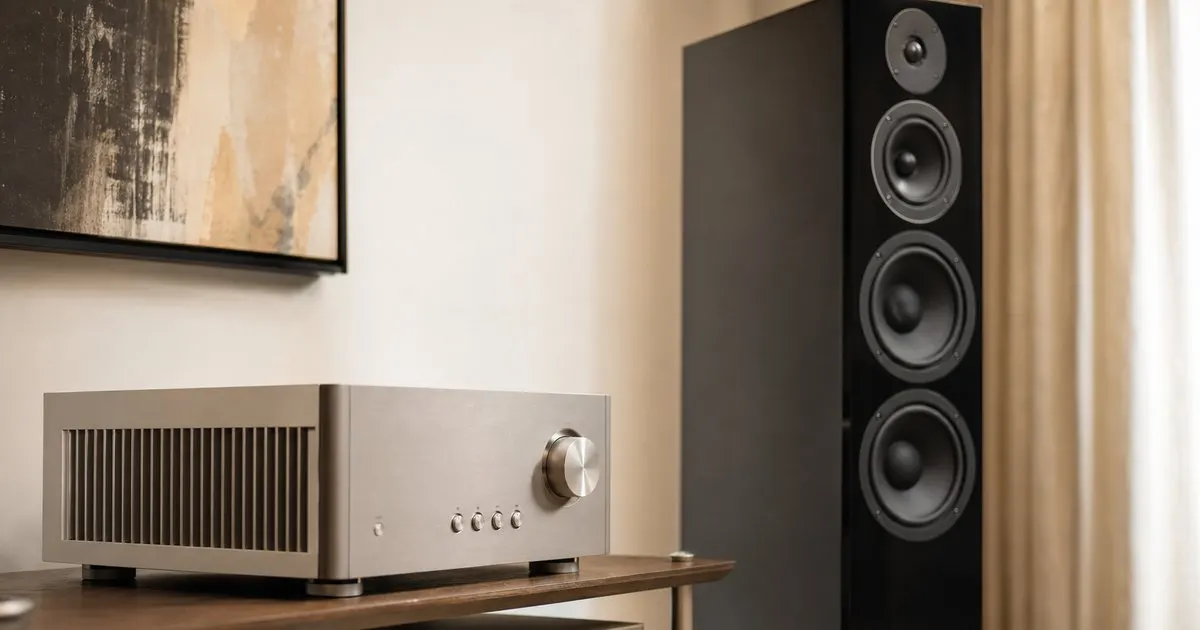
Sensitivity and power in balance
A loudspeaker's sensitivity describes how loudly it plays for a given input, and it tells you how much amplifier power you truly need. Efficient speakers thrive on modest power, while demanding ones ask for more. Related: How Do You Audition Reference Loudspeakers So The Demo Predicts Your Room?
Matching power to sensitivity avoids two failures, an amplifier that cannot drive the speakers to life, and one so overspecified that its quality never shows. The right pairing meets in the middle.
Keep reading: How Do You Build A Reference Hi-Fi System Without Wasting Money?, Which Component Deserves The Largest Share Of Your Hi-Fi Budget?, Why Does The Listening Room Shape Your Sound More Than Expected?. See how Sonoholm helps you an audiophile guide to reference loudspeakers and hi-fi.
Impedance and how a speaker loads the amplifier
Impedance is the electrical load the speaker presents, and it can vary across frequencies. Some speakers are an easy load, others dip low and demand an amplifier stable enough to cope.
An amplifier comfortable with a difficult load keeps its composure at the frequencies where music lives. Ignoring impedance is a common reason a promising pairing sounds strained or thin.
Tonal character and voicing
Beyond the numbers, components have a voice. A slightly warm amplifier can flatter a revealing speaker, while two lean or two rich components together can push the balance too far in one direction. Related: Should You Buy Separate Components Or A Single Integrated Amplifier First?
Good matching aims for a natural whole. The goal is not to cancel flaws but to choose partners whose characters complement rather than compound, so the system sounds like music rather than equipment. Related: Can A Compact System Ever Sound As Good As A Large One?
The room completes the match
The finest pairing still answers to the room. Placement, reflections, and dimensions shape bass and imaging, so a match that sings in one space may need adjustment in another. Related: Why Does The Listening Room Shape Your Sound More Than Expected?
Judge any pairing in your own room, with attention to placement. The interaction of speaker, amplifier, and space is the real test, and it is where a genuine match proves itself.
- Match amplifier power to speaker sensitivity
- Choose an amplifier stable with the speaker's impedance
- Pair tonal characters that complement each other
- Confirm the match in your own room

Julien Jimenez
Julien Jimenez is an independent software builder based in Paris. He designs, ships, and operates focused SaaS products for small businesses and independent professionals. Read the full author page.
Frequently asked questions
Can a powerful amplifier damage sensitive speakers?
Clipping from an underpowered amplifier is a more common cause of damage than clean power. Sensible matching and reasonable volume matter more than raw wattage, so focus on quality and stability over sheer output.
Do tube and solid state amplifiers match speakers differently?
Yes. Tubes often suit efficient, easy load speakers and add a particular warmth, while solid state generally drives demanding loads more firmly. The best choice depends on your speakers and the sound you prefer.
Music As The Artist Intended
An audiophile guide to reference loudspeakers and hi-fi. Sonoholm is built to help you put this into practice.
Build your systemMore from the Sonoholm blog
How Do You Build A Reference Hi-Fi System Without Wasting Money?
Which Component Deserves The Largest Share Of Your Hi-Fi Budget?
Why Does The Listening Room Shape Your Sound More Than Expected?
Get the complete reference hi-fi audio guide
Our full buying guide, the price guide, and new research as we publish it. One email, no spam, unsubscribe any time.