Why Does A Subwoofer Still Belong In A Two Channel Reference System?
Even large floorstanders leave the bottom octave and the room's bass problems partly unsolved. A properly integrated subwoofer, or a pair, addresses both without diluting the purist approach.
What full-range loudspeakers still leave on the table
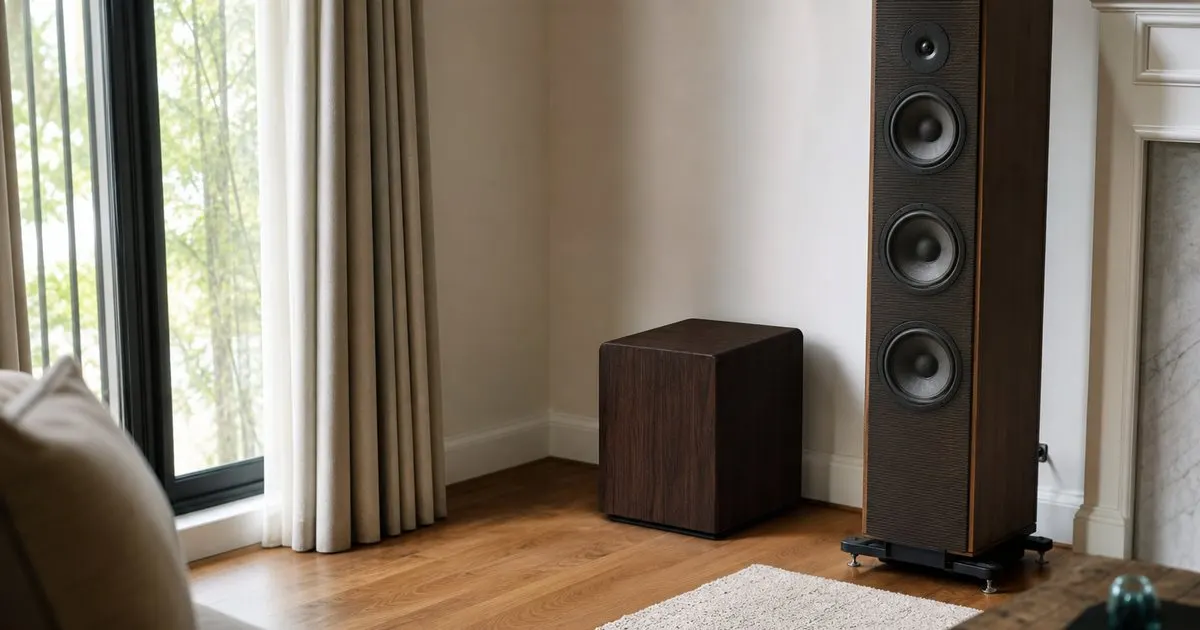
Most floorstanding loudspeakers, even large and expensive ones, begin to roll off in the low 30s of Hertz once placed in a real room, and the region below that is where pipe organ pedals, synthesizer foundations, and the sense of a hall's physical size actually live. A capable subwoofer extends flat response into the low 20s or beyond. Just as important, the subwoofer's position is not tied to stereo imaging. It can sit where the room's bass modes are excited most evenly, while the main loudspeakers stay exactly where they image best, a freedom no full-range speaker enjoys. Related: What Makes Loudspeakers And Amplifiers Truly Match In A Real Room?
There is a second, less obvious benefit. Applying a high-pass filter to the main loudspeakers relieves their woofers and the main amplifier of the lowest octave, where the most excursion and the most power are consumed. Distortion in the midbass drops, dynamic headroom rises, and the main amplifier stops working near its limits on demanding passages. Purists worry about extra electronics in the signal path, and the concern is reasonable. In practice, the improvement in dynamics and clarity from high-passing the mains usually outweighs any loss, and many modern approaches keep the filter out of the main signal path entirely.
Keep reading: How Do You Build A Reference Hi-Fi System Without Wasting Money?, What Makes Loudspeakers And Amplifiers Truly Match In A Real Room?, Which Component Deserves The Largest Share Of Your Hi-Fi Budget?. See how Sonoholm helps you an audiophile guide to reference loudspeakers and hi-fi.
One subwoofer or two, and where they belong
A single subwoofer in a rectangular room excites the room's modes unevenly, which means the bass can be smooth at one seat and lumpy at the next. Two subwoofers placed symmetrically, at the front wall midpoints or in opposite corners, smooth the response across a wider listening area and are the sensible choice for a shared room. For a single listening chair, one carefully placed subwoofer can be superb. The well-known crawl technique works: put the subwoofer at the listening seat, play a repeating bass passage, and move around the room at floor level to find where the bass sounds most even, then place the subwoofer there. Related: Why Does The Listening Room Shape Your Sound More Than Expected?
Sealed subwoofers tend to integrate more naturally with music because their roll-off is gentler and their transient behavior is more controlled, while ported designs deliver more output per dollar and are favored for cinema use. For a reference two-channel system, a sealed cabinet with a substantial long-throw driver and a plate amplifier with built-in equalization is a common and sound choice. Cabinet size matters less than it once did, because modern amplification allows a compact sealed box to reach very low with real authority. Related: How Do You Build A Reference Hi-Fi System Without Wasting Money?
Crossover, phase, and level: the integration work
The crossover point typically lands somewhere between 40 and 80 Hz, depending on how low the main speakers reach on their own. Set it too high and the subwoofer becomes locatable, which is the sound everyone remembers from badly integrated systems. Phase and delay must then be adjusted so that the subwoofer and the mains sum correctly through the crossover region. A calibrated microphone and measurement software make this a fifteen-minute job; by ear, a track with a repeating bass note near the crossover frequency, adjusted until it sounds fullest, is a workable substitute.
Level is where most people go wrong. The correct setting is a touch lower than the one that seems exciting on first listen. The goal is not to hear the subwoofer but to miss it when it is switched off. Equalization built into the subwoofer's amplifier is very good at cutting the one or two dominant room peaks, which is where it should be used; boosting into a null is inefficient and can push the driver toward its limits. Tame the worst peak, leave the rest alone, and then live with the system for a week before touching anything again.
Choosing a subwoofer worthy of a reference system
At the level of a 5,000 to 15,000 USD main system, expect a subwoofer with a heavily braced cabinet, a driver with generous excursion, an amplifier with ample reserve, and control via a front panel or an app that includes parametric equalization and adjustable phase. Speaker-level inputs, sometimes called high-level inputs, let the subwoofer take its signal from the main amplifier's outputs and preserve the character of that amplifier through the bass. Balanced line inputs suit preamplifiers with a second set of outputs, and some designs offer a high-pass output for the mains.
Consider finish alongside performance. A subwoofer that matches the veneer or lacquer of the main loudspeakers is far more likely to be allowed to stay where it works best rather than being pushed behind a sofa. Subwoofers remain one of the least glamorous purchases in high-end audio and one of the most effective per dollar. Guides like this one may earn a commission on a linked model, but the model matters less than the integration effort, and no subwoofer, however expensive, fixes a lazy setup. Related: Are Expensive Cables And Isolation Worth The Investment In High Fidelity?
- Even large floorstanders roll off in the low 30s Hz in-room; a subwoofer extends the foundation and can be placed for the room rather than for imaging.
- High-passing the main loudspeakers lowers distortion and raises dynamic headroom, which is usually a bigger gain than any loss from the filter.
- Two subwoofers smooth bass across a shared room; one well-placed subwoofer serves a single listening chair.
- Set the crossover low, get the phase right, and run the level a touch lower than seems exciting so the subwoofer disappears.

Julien Jimenez
Julien Jimenez is an independent software builder based in Paris. He designs, ships, and operates focused SaaS products for small businesses and independent professionals. Read the full author page.
Music As The Artist Intended
An audiophile guide to reference loudspeakers and hi-fi. Sonoholm is built to help you put this into practice.
Build your systemMore from the Sonoholm blog
How Do You Build A Reference Hi-Fi System Without Wasting Money?
What Makes Loudspeakers And Amplifiers Truly Match In A Real Room?
Which Component Deserves The Largest Share Of Your Hi-Fi Budget?
Get the complete reference hi-fi audio guide
Our full buying guide, the price guide, and new research as we publish it. One email, no spam, unsubscribe any time.