How Much Amplifier Power Does A Low Sensitivity Reference Loudspeaker Really Need?
Sensitivity ratings, impedance dips, room size, and listening distance together decide the honest answer. Here is how to calculate headroom rather than guess at it.
Reading sensitivity and impedance honestly
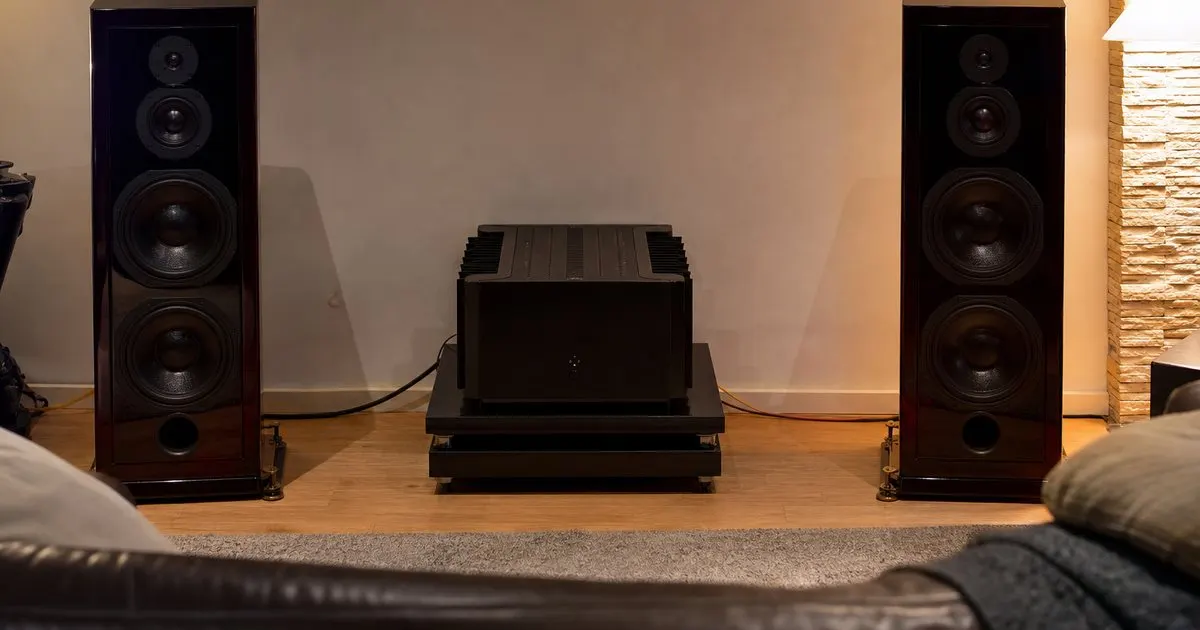
Sensitivity is usually quoted as the sound pressure level at one meter with either one watt or 2.83 volts applied. The distinction matters. Into an 8 ohm load, 2.83 volts is one watt; into a 4 ohm load it is two watts, so a 4 ohm speaker quoted at 2.83 volts looks 3 dB more sensitive than it really is on a per-watt basis. Speakers in the mid 80s dB region are low sensitivity by any reasonable standard, while designs in the low 90s are relatively easy to drive. Each 3 dB less sensitivity requires double the power for the same level, which is the whole crux of the calculation. Related: Why Does The Listening Room Shape Your Sound More Than Expected?
The nominal impedance figure hides the second half of the story. A speaker described as 4 ohms may dip toward 3 ohms or lower in the bass, and when that dip coincides with a steep electrical phase angle, the amplifier must deliver current rather than just voltage. Two amplifiers with the same wattage into 8 ohms can behave completely differently into such a load. Ask the manufacturer for the impedance curve, or look for the minimum impedance and its frequency in independent measurements, before you think about watts at all. Related: What Makes Loudspeakers And Amplifiers Truly Match In A Real Room?
Keep reading: How Do You Build A Reference Hi-Fi System Without Wasting Money?, What Makes Loudspeakers And Amplifiers Truly Match In A Real Room?, Which Component Deserves The Largest Share Of Your Hi-Fi Budget?. See how Sonoholm helps you an audiophile guide to reference loudspeakers and hi-fi.
The arithmetic of headroom in your room
Start with your listening distance and a target for clean peaks. In a typical furnished room, the level from one speaker drops by roughly 6 to 8 dB between one meter and three meters, and two speakers playing together add back roughly 3 to 6 dB depending on how correlated the signal is. A speaker rated at 85 dB for one watt therefore delivers somewhere around 81 to 82 dB at a three meter seat with one watt per channel. Well-mastered orchestral and acoustic recordings can carry peaks 15 to 20 dB above their average level, so an average of 80 dB implies peaks near 100 dB. Related: When Should You Choose Standmount Speakers Over Larger Floorstanding Models?
Every 10 dB of extra level requires ten times the power, and every 3 dB requires double. Reaching 100 dB peaks from a base of about 82 dB per watt calls for roughly 18 dB of gain above one watt, which works out to something on the order of 60 to 80 watts per channel of clean, unclipped power. Push the target to 105 dB and the requirement jumps past 200 watts. This is why most listening happens on a watt or two while the amplifier's real job is defined by the peaks, and why an amplifier that clips on a fortissimo passage has failed at the only moment that mattered.
Current, damping, and why the bass reveals a mismatch
When an amplifier runs out of current on an impedance dip, the symptoms are consistent: bass loses definition and turns soft, crescendos flatten as the amplifier compresses, and the treble hardens as clipping begins. Listeners often blame the loudspeaker or the source for a problem that is entirely about the amplifier's power supply. A useful sign of a robust design is a power rating that increases substantially from 8 ohms to 4 ohms; an amplifier that doubles its output as the load halves is behaving like a true voltage source with current to spare.
Damping factor, the ratio of speaker impedance to amplifier output impedance, is quoted with great enthusiasm in marketing and matters only modestly in practice. Beyond a moderate value, further increases produce little audible change for most speakers, and what actually matters is stability into reactive loads without the amplifier's protection circuits engaging. Manufacturers often publish a recommended amplifier power range for a given speaker. Treat the low end of that range as a minimum for a small room at gentle levels, not as a target.
Choosing between more watts and better watts
At 5,000 to 15,000 USD, the budget can buy either a large, high-current amplifier with abundant reserves or a smaller, exquisitely refined design with modest power. For a low sensitivity reference speaker in a medium or large room, prioritize reserves. Refinement counts for little when the amplifier hardens on a chorus, and the most beautiful midrange in the world does not survive clipping. In a small room, at modest levels, the calculus flips, and a lower-powered amplifier of superb quality can be the more musical choice. Related: How Do You Build A Reference Hi-Fi System Without Wasting Money?
Bi-amplification and monoblocks are sometimes sold as cures; they help mainly by adding current capability and by giving each channel its own power supply, which can matter with demanding loads. Before spending on either, run the honest test: have the candidate amplifier drive the candidate loudspeakers at the peak levels you really listen at. A sound level meter or a phone app will show you how loud you actually play, and many listeners discover their real peaks are lower, or higher, than they assumed. That number, not the brochure, decides how much power you need.
- Check whether sensitivity is quoted per watt or at 2.83 volts, and find the minimum impedance and phase angle, before thinking about wattage.
- Every 3 dB of extra level doubles the power required, so peaks rather than average level define the amplifier you need.
- A mid 80s dB speaker at a three meter seat typically needs on the order of 60 to 80 clean watts for 100 dB peaks, and far more for louder listening.
- Prefer an amplifier whose rated power rises meaningfully into 4 ohms, and test at your real peak levels before buying.

Julien Jimenez
Julien Jimenez is an independent software builder based in Paris. He designs, ships, and operates focused SaaS products for small businesses and independent professionals. Read the full author page.
Music As The Artist Intended
An audiophile guide to reference loudspeakers and hi-fi. Sonoholm is built to help you put this into practice.
Build your systemMore from the Sonoholm blog
How Do You Build A Reference Hi-Fi System Without Wasting Money?
What Makes Loudspeakers And Amplifiers Truly Match In A Real Room?
Which Component Deserves The Largest Share Of Your Hi-Fi Budget?
Get the complete reference hi-fi audio guide
Our full buying guide, the price guide, and new research as we publish it. One email, no spam, unsubscribe any time.