When Should You Buy Used Or Dealer Demo Reference Loudspeakers Instead Of New?
Pre-owned and ex-demonstration loudspeakers can put a genuinely higher tier of performance within reach. The trade-offs are real but manageable once you know what to inspect and what to ask.
What depreciation looks like in high-end loudspeakers
Loudspeakers at the reference tier tend to hold value better than electronics with digital circuitry, because a well-built cabinet and a set of quality drivers do not become obsolete the way a streaming board or a USB input does. Even so, a pair that has been on the market for a few years typically sells for a meaningful amount below its original retail price, and a dealer demonstration pair that has spent months on the showroom floor is commonly offered at a discount with the balance of the warranty intact. That gap is what makes buying used attractive: the same budget can reach a model one or two rungs higher in a manufacturer's range. Related: How Do You Build A Reference Hi-Fi System Without Wasting Money?
The sweet spot is a current model or one that has just been superseded, from a manufacturer that still supplies replacement drivers and offers a repair service. Discontinued lines from companies that no longer exist carry a different kind of risk. A failed tweeter on such a pair can be impossible to replace with an original part, and substitutes change the crossover behavior and the tonal balance. Before you get excited about a bargain, check the maker's website or call their service department and ask whether drivers for that model are still available and at what cost.
Keep reading: How Do You Build A Reference Hi-Fi System Without Wasting Money?, What Makes Loudspeakers And Amplifiers Truly Match In A Real Room?, Which Component Deserves The Largest Share Of Your Hi-Fi Budget?. See how Sonoholm helps you an audiophile guide to reference loudspeakers and hi-fi.
Dealer demo pairs: the lower-risk route
A demonstration pair has been played, which for a loudspeaker is a benefit rather than a concern, and it has been handled by people who move loudspeakers for a living, stored in a climate-controlled room, and usually kept with its original packaging, which matters enormously for transport. Ask specifically about the warranty. Many manufacturers honor the full term from the date of sale to the first retail customer even for demo stock, while others prorate the remaining period. Get the answer in writing on the invoice. Related: Why Does The Listening Room Shape Your Sound More Than Expected?
Inspect the cabinets in good light for the wear that showrooms produce: dings on lower corners from being shifted around, faint marks where grilles clip on, and veneer that has faded on one side if the pair sat near a window. Ask how the pair was used, whether it traveled to shows, and whether it was ever driven hard for a demonstration. A demo purchase is also a natural moment to negotiate the extras that make a real difference: stands, a set of cables, delivery and setup in your own room, or a home trial of an amplifier to go with them. Related: What Makes Loudspeakers And Amplifiers Truly Match In A Real Room?
Private sales: what to inspect and how to test
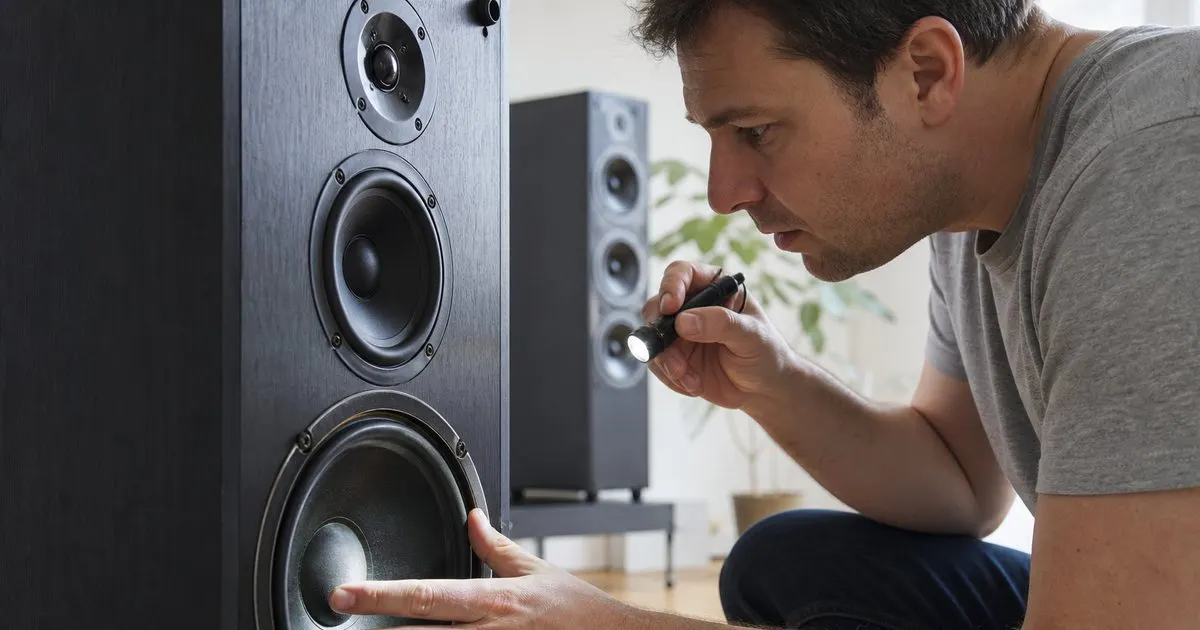
Insist on hearing a private-sale pair in person, and at realistic volume, before money changes hands. Play a familiar track with sustained bass and listen from close range for buzzes and rattles, which point to loose driver screws, a delaminating surround, or a cabinet panel that has come unglued. Listen to each driver individually with your ear a few inches away and compare left to right; the tweeters in particular should match in level and character. With the grille off, press very gently on each woofer cone with fingertips spread evenly and feel for scratching resistance, which suggests a rubbing voice coil.
Look at surrounds for cracking or foam rot on older designs, check that binding posts turn freely and crossover jumpers are present, and run a hand along cabinet joints for gaps. Ask for the original receipt, the boxes, and the owner's manual. Pay through a method that offers recourse, and factor freight into the price honestly: a heavy floorstanding pair costs real money to ship on a pallet, and a pair shipped without factory packaging is one of the most common horror stories in this hobby. If at all possible, collect in person, wrapped and upright in your own vehicle.
When buying new is the better decision
Buy new when the model has recently been revised and the changes address something you care about, when a home trial and a return window are part of how you make decisions, when you want the full warranty period and a dealer relationship for setup and future service, or when finish matters. Veneers on a factory pair are typically book-matched from the same batch of wood, and if one used cabinet is damaged later, sourcing a cosmetically matched replacement is nearly impossible.
Compare the full picture rather than the sticker. A used pair at a tempting price plus freight, plus a reasonable risk allowance, plus the cost of a new set of packaging if the boxes are gone, may land closer to a new pair than expected, especially when a dealer is clearing stock at the end of a model cycle or will take your existing speakers in part exchange. As a general rule, buying used favors loudspeakers and analog amplifiers, where the technology ages slowly, and favors it less for DACs and streamers, which are the fastest-aging components in any reference system. Related: Should You Buy Separate Components Or A Single Integrated Amplifier First?
- Loudspeakers depreciate more slowly than digital electronics, so a used pair can reach a higher tier of performance for the same budget.
- Dealer demo pairs usually arrive with packaging, professional handling, and some warranty, which makes them the lowest-risk pre-owned option.
- Private sales demand an in-person listen, a driver-by-driver inspection, and a realistic freight and packaging budget.
- New wins when a home trial, the full warranty, matched veneers, or a recent design revision matters more than the discount.

Julien Jimenez
Julien Jimenez is an independent software builder based in Paris. He designs, ships, and operates focused SaaS products for small businesses and independent professionals. Read the full author page.
Music As The Artist Intended
An audiophile guide to reference loudspeakers and hi-fi. Sonoholm is built to help you put this into practice.
Build your systemMore from the Sonoholm blog
How Do You Build A Reference Hi-Fi System Without Wasting Money?
What Makes Loudspeakers And Amplifiers Truly Match In A Real Room?
Which Component Deserves The Largest Share Of Your Hi-Fi Budget?
Get the complete reference hi-fi audio guide
Our full buying guide, the price guide, and new research as we publish it. One email, no spam, unsubscribe any time.