How Do You Audition Reference Loudspeakers So The Demo Predicts Your Room?
A dealer demonstration can flatter almost any loudspeaker. Here is how to structure an audition so that what you hear in the showroom survives the trip home.
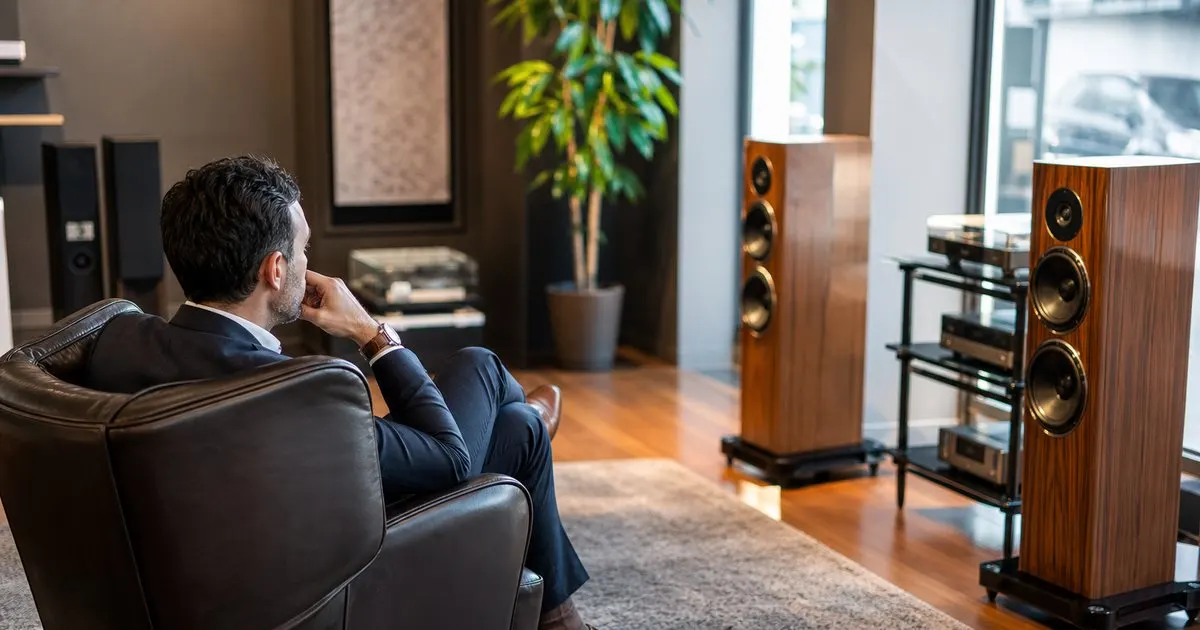
Why showroom conditions rarely match your living room
A good dealer builds the demonstration room around the loudspeakers. The walls are treated, the speakers sit well away from boundaries, the listening chair is placed precisely in the stereo sweet spot, and the electronics are often chosen because they flatter that particular pair. Your living room has a fireplace, a glass door, a sofa pushed against the back wall, and a speaker position dictated by where the furniture can go. The bass region depends heavily on room dimensions and how close the cabinets sit to walls, so a pair that sounds taut and articulate in a large treated space can turn thick and boomy in a smaller domestic room. Related: What Makes Loudspeakers And Amplifiers Truly Match In A Real Room?
There is nothing dishonest in this. The dealer wants the product heard at its best, the recordings on hand are chosen to impress, and the level is usually a notch louder than you would play at home, which almost always sounds better in the moment. Your task is not to distrust the showroom but to control the variables that you can control, and to know which impressions will transfer to your room and which will not. Imaging, tonal character, midrange resolution, and behavior at low volume generally transfer well. Bass weight and the sense of scale transfer poorly.
Keep reading: How Do You Build A Reference Hi-Fi System Without Wasting Money?, What Makes Loudspeakers And Amplifiers Truly Match In A Real Room?, Which Component Deserves The Largest Share Of Your Hi-Fi Budget?. See how Sonoholm helps you an audiophile guide to reference loudspeakers and hi-fi.
Prepare a listening kit before you go
Bring your own music, ideally eight to twelve tracks you know intimately. Include a plainly recorded solo voice, an acoustic piano recording, something with dense, layered production, a track with sustained low bass, and at least two ordinary commercial releases rather than audiophile showpieces. Reference loudspeakers at 5,000 to 15,000 USD should make ordinary records enjoyable, not merely tolerable. Bring the files at the resolution you actually use at home, and if you stream from a subscription service, bring the phone or tablet you use so the source chain resembles your own. Related: How Do You Build A Reference Hi-Fi System Without Wasting Money?
Ask what electronics are driving the speakers before you sit down. If the amplifier costs several times what you plan to spend, ask to hear the pair on something closer to your budget, or on the exact model you own if the dealer stocks it. Note the room dimensions, measure the distance from the cabinets to the front and side walls, and photograph the setup for later comparison with your own space. When comparing two pairs, ask for the levels to be matched with a meter. A difference of a decibel or so is enough to tilt preference toward the louder pair, and most listeners cannot detect that the levels differ. Related: When Should You Choose Standmount Speakers Over Larger Floorstanding Models?
How to listen once the music starts
Spend at least thirty to forty-five minutes with a single pair before switching. Rapid comparisons reward the more vivid presentation, which is rarely the one you will want to live with over years. Listen for what tires the ear over time: sibilance on voices, hardness in massed strings, a bass that draws attention to itself. Then get up. Walk to the side of the room, stand behind the chair, sit on the floor. A speaker that collapses tonally outside the sweet spot will disappoint in a shared living space where nobody sits in the perfect seat for long. Related: Why Does The Listening Room Shape Your Sound More Than Expected?
Listen at low volume as well as at your usual level. A genuinely refined loudspeaker stays tonally complete and rhythmically engaging at conversational volume, and most evenings at home are not full-scale sessions. If your room forces the speakers close to the wall, ask the dealer to move them back to approximate that placement, even if it makes the demo less flattering; you are buying for your room, not theirs. Write your notes immediately after each pair, before discussing anything with the salesperson. Memory for sound is short, easily suggestible, and quickly overwritten by conversation.
Negotiate a home trial or a clear return window
At this level of spending, a home trial is a reasonable request rather than an imposition. Many specialist dealers will lend a demonstration pair for a weekend, deliver and set up in your room, or offer a return period with a restocking fee. Ask before you fall in love with anything. Clarify who transports the speakers, who carries the insurance while they are in your home, what condition is expected on return, and whether the trial pair is the exact finish and revision you would be buying.
If a home trial is impossible, arrange a second audition on a different day, with different electronics if possible, and in a different frame of mind. Serious buyers also benefit from a modest measurement kit at home: a calibrated microphone and free measurement software will reveal where your room has bass peaks and nulls, so you can ask the dealer precise questions about how a candidate speaker behaves near boundaries. One last note on independence: guides like this one may earn a commission when you buy through a link, and that does not change the advice. The audition process above is the same whether you buy from a recommended dealer or one across town.
- Showroom bass and scale rarely transfer to a domestic room, while tonal character, imaging, and low-volume behavior usually do.
- Bring your own recordings, including ordinary commercial releases, and insist on level-matched comparisons using a meter.
- Stay with a single pair for a long stretch, move around the room, and listen at low volume before forming a view.
- Secure a home trial or a written return window before committing to a purchase at this price tier.

Julien Jimenez
Julien Jimenez is an independent software builder based in Paris. He designs, ships, and operates focused SaaS products for small businesses and independent professionals. Read the full author page.
Music As The Artist Intended
An audiophile guide to reference loudspeakers and hi-fi. Sonoholm is built to help you put this into practice.
Build your systemMore from the Sonoholm blog
How Do You Build A Reference Hi-Fi System Without Wasting Money?
What Makes Loudspeakers And Amplifiers Truly Match In A Real Room?
Which Component Deserves The Largest Share Of Your Hi-Fi Budget?
Get the complete reference hi-fi audio guide
Our full buying guide, the price guide, and new research as we publish it. One email, no spam, unsubscribe any time.