Which DAC Features Actually Matter When You Spend Serious Money On Digital?
Specification sheets for digital converters are crowded with numbers that rarely predict how a unit sounds or how well it fits a reference system. These are the features that deserve your money.
Why the headline specifications are a poor guide
Nearly every competently designed converter above a modest price handles more resolution than any commercial recording contains. Maximum sample rates, bit depths, and vanishingly small distortion figures are table stakes rather than differentiators at the reference tier, and two units with nearly identical measurements can sound noticeably different in a system. The audible differences tend to come from the analog output stage, the quality and isolation of the power supply, the design of the digital filter, and how gracefully the unit deals with timing errors arriving from its inputs. Related: Why Does The Listening Room Shape Your Sound More Than Expected?
The more productive way to evaluate a converter is to think about system fit rather than the spec race. Which inputs will you actually use, and from what sources? Does your amplifier have balanced inputs that would benefit from balanced outputs? Will you use the converter's own volume control and skip a preamplifier altogether? How is the maker's record on firmware support and service? These questions decide whether a 5,000 to 15,000 USD converter becomes the settled heart of a digital system or an expensive stepping stone. Related: What Makes Loudspeakers And Amplifiers Truly Match In A Real Room?
Keep reading: How Do You Build A Reference Hi-Fi System Without Wasting Money?, What Makes Loudspeakers And Amplifiers Truly Match In A Real Room?, Which Component Deserves The Largest Share Of Your Hi-Fi Budget?. See how Sonoholm helps you an audiophile guide to reference loudspeakers and hi-fi.
Inputs, outputs, and the preamplifier question
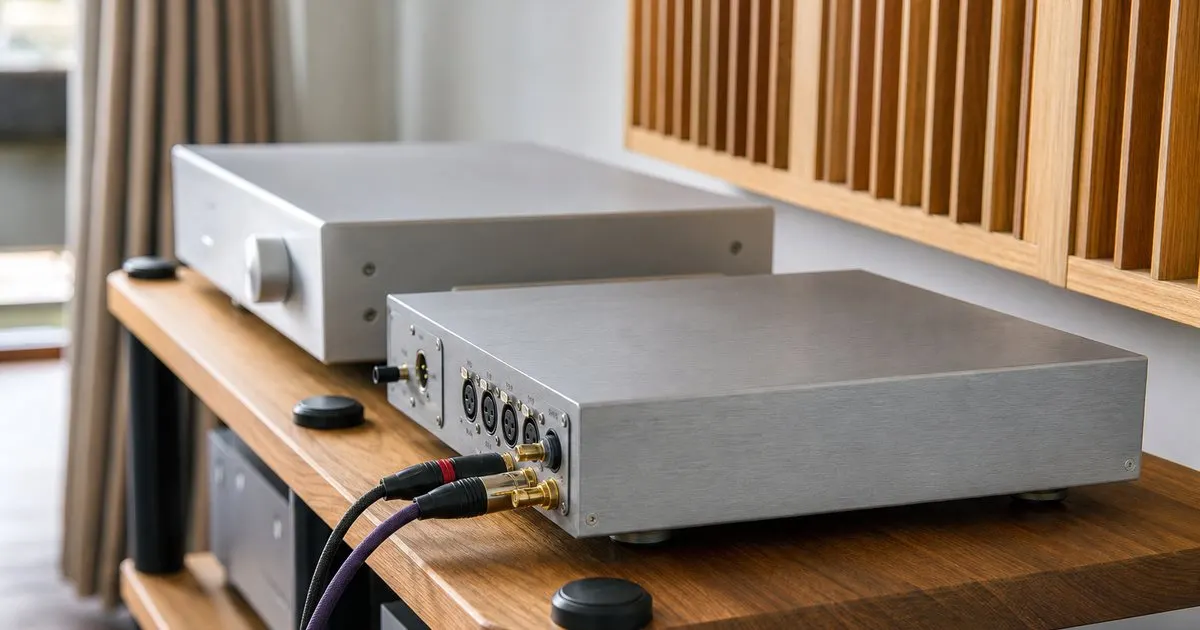
Map your sources first. A network streamer or a computer typically connects over USB or, in more professional-leaning designs, over an AES/EBU connection; a disc transport or a television uses coaxial or optical; and a converter with a built-in network board can take a direct connection to your router and remove a box entirely. On the output side, balanced XLR connections earn their keep over longer runs and into amplifiers with true balanced input stages, while single-ended RCA outputs are entirely adequate for short cables into most integrated amplifiers.
Many reference converters now include a volume control refined enough to drive a power amplifier directly. Digital volume implemented in a high-resolution domain loses very little, and some designs use analog attenuation with excellent results, but implementation varies widely. If you intend to run without a preamplifier, audition the converter that way, at the attenuation level you will actually use, because some units lose body and drive when attenuated heavily. If you already own a preamplifier you love, a fixed-output converter is simpler, and the money saved on the volume stage can go toward the output stage and power supply. Related: How Do You Build A Reference Hi-Fi System Without Wasting Money?
Filters, upsampling, and what you can genuinely hear
Selectable digital filters produce subtle but real differences, most audible on cymbal decay and vocal sibilance with standard-resolution material. Linear-phase filters tend to sound precise and slightly forward, minimum-phase filters a little softer at the leading edge, and slow roll-off options trade a touch of treble extension for a more relaxed presentation. Do not buy a converter for the size of its filter menu. Find the setting that sounds right on familiar recordings, note it, and forget about it. A design with one very well-executed filter can be more satisfying than one with a dozen options.
Format support beyond conventional high-resolution PCM and the common DSD rates covers practically everything you will ever play, and proprietary formats have become less relevant as streaming services moved toward open lossless delivery. Internal upsampling and external upsampling boxes have advocates and skeptics; the effect depends on the specific design and on the filter behavior it enables, and a native design that does not upsample can be entirely convincing. What matters more in the long run is that the maker ships firmware updates that fix problems and keep inputs compatible with the sources you will own in five years. Related: Does Vinyl Truly Outperform High Resolution Streaming For Serious Listeners Today?
Build, power supplies, and long-term ownership
Lift a candidate converter. At this tier, a substantial chassis and a linear power supply are typical, and they tend to correlate with quieter backgrounds and a more solid presentation, though there are excellent designs that use well-engineered switching supplies. Some makers offer a separate power supply box; it adds cost, cables, and shelf space, and the benefit depends entirely on how compromised the internal supply was to begin with. Ask to hear the difference in the dealer's system before adding a second chassis.
Digital ages faster than anything else in a reference system, so consider how the unit will fit in five years. Is the network module upgradable? Does the maker have a history of supporting older products with parts and firmware? Are the connectors and protocols mainstream enough that new sources will still talk to it? A converter bought at this price should be an endpoint rather than a stepping stone, and the makers that treat it that way, with modular designs and long service commitments, are the ones that justify the spend. If you buy through a link from a guide like this one, a commission may be earned; the criteria above do not change.
- Sample rate ceilings and distortion figures rarely separate reference converters; the output stage, power supply, and filter design do.
- Map your real sources and your amplifier's inputs before comparing units, and audition any converter you plan to use without a preamplifier at the attenuation you will actually use.
- Pick the filter that sounds right on your own recordings and move on; the size of the menu is not a feature.
- Favor makers with modular designs and a track record of firmware and service support, because digital ages fastest.

Julien Jimenez
Julien Jimenez is an independent software builder based in Paris. He designs, ships, and operates focused SaaS products for small businesses and independent professionals. Read the full author page.
Music As The Artist Intended
An audiophile guide to reference loudspeakers and hi-fi. Sonoholm is built to help you put this into practice.
Build your systemMore from the Sonoholm blog
How Do You Build A Reference Hi-Fi System Without Wasting Money?
What Makes Loudspeakers And Amplifiers Truly Match In A Real Room?
Which Component Deserves The Largest Share Of Your Hi-Fi Budget?
Get the complete reference hi-fi audio guide
Our full buying guide, the price guide, and new research as we publish it. One email, no spam, unsubscribe any time.