What Is The Best Way To Set Up A Music Server And Home Network For Critical Listening?
How to build the digital front end behind a reference system: where the network genuinely matters, how to hold and protect a library, and which upgrades are audible rather than theoretical.
What A Network Can And Cannot Do To The Sound
Two claims about digital audio are both true and are constantly confused with each other. The first is that the data itself arrives intact. Streaming and file playback use error corrected protocols with buffering, so a file that reaches your converter is bit for bit the file that left the drive, or it fails audibly and obviously rather than sounding subtly worse. Nothing about a longer cable or a busier router changes the numbers. Anyone selling you a network product on the promise of better bits is selling you a misunderstanding.
The second claim is about everything that travels alongside the data. Network gear is full of switching power supplies, clock oscillators and ethernet transformers, and the noise they generate can reach the ground plane of a converter, where the analog output stage and the clock are genuinely sensitive to it. That is a real mechanism with a real effect on the noise floor, and it is why an isolated, quiet transport can be audible while an expensive cable between two switches usually is not. Keep this distinction in mind and you will spend money in the right places: on isolation and on the quality of the device closest to your converter, not on the plumbing three rooms away. Related: Are Expensive Cables And Isolation Worth The Investment In High Fidelity?
Keep reading: How Do You Build A Reference Hi-Fi System Without Wasting Money?, What Makes Loudspeakers And Amplifiers Truly Match In A Real Room?, Which Component Deserves The Largest Share Of Your Hi-Fi Budget?. See how Sonoholm helps you an audiophile guide to reference loudspeakers and hi-fi.
Holding The Library: Storage, Ripping And Backup
Decide first whether you own music or rent it. A subscription service is convenient and its top tiers now deliver genuinely high resolution material, but catalogs change, licenses lapse and favorite versions disappear without notice. Most serious listeners end up with both: a service for discovery and a permanent local library of the recordings that matter. Rip discs with software that verifies each track against a checksum database so you know the copy is accurate, store the results as lossless files, and spend real effort on metadata and cover art at ingest time. Correcting a badly tagged library of ten thousand tracks later is a genuinely miserable weekend.
Storage should be dull and redundant. A network attached drive enclosure in a cupboard or a modest solid state drive inside the server both work; what matters is that the library exists in at least two places, one of them off site or in cloud storage, and that you have actually tested a restore. Drives fail without warning and a decade of ripping is not replaceable by insurance. Keep the working library on quiet storage close to the player and treat the backup as archival. If you use spinning drives, put them somewhere their noise and vibration cannot reach the listening room, because mechanical hum in a quiet passage is far more damaging than any theoretical jitter. Related: Why Does The Listening Room Shape Your Sound More Than Expected?
Topology: Wired Runs, Isolation And The Last Metre
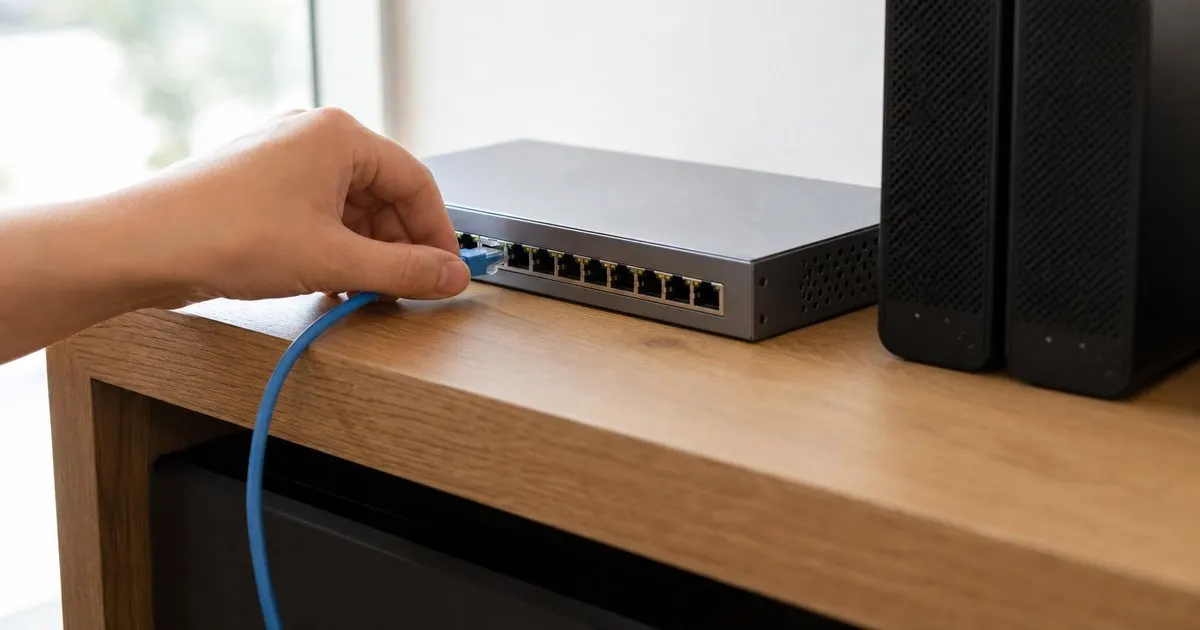
Run wired ethernet to the listening room. Wireless works, and a well placed access point is fine for casual listening, but a cable removes an entire class of dropout and retry behavior and lets you put the noisy network hardware somewhere else in the house. Keep the router, the main switch and any powerline adapters well away from the rack. If you want one network upgrade with a defensible mechanism, add galvanic isolation on the last hop before the streamer, either through a fibre segment with media converters or through an isolating switch. That breaks the electrical path between the house network and your audio ground without changing a single bit of data.
The last meter matters most. A dedicated streamer with a linear supply, or a purpose built server, is generally a cleaner transport than a general purpose laptop sitting on the rack with its charger plugged in beside your preamplifier. If your converter accepts a network input directly, that is usually the shortest and quietest path, since it removes the separate transport and its cable entirely. If you feed the converter over USB, keep the cable short, use the converter's own isolation if it has it, and resist the temptation to stack accessories. Every additional box in the chain is another power supply and another ground connection you have to justify by listening.
Software, Control And Living With It For Years
The playback software you choose shapes daily use more than any component in this article. You want a library manager that handles classical and jazz metadata properly, since composer, conductor, ensemble and recording date are the fields casual software abandons first. You want gapless playback that actually works on live albums and opera. You want a phone or tablet control app that responds instantly, because a laggy remote is the single most common reason an expensive system stops being used. Try the software before you buy hardware built around it, and check that it can play from both your local library and your streaming subscription in one unified view. Related: Which Component Deserves The Largest Share Of Your Hi-Fi Budget?
Plan for the decade, not the launch. The most future proof arrangement keeps the library, the transport and the conversion as three separable parts, so you can replace the converter when standards move without rebuilding the whole front end, and so your files outlive any one manufacturer's app. Store music in open lossless formats rather than a proprietary container. Keep a written note of your folder structure and backup routine somewhere your family can find it. Budget accordingly: in a reference system, a competent streamer, a quiet wired run, honest backup and good software will take you further than a costly network accessory, and it is the part of the system you touch every single day. Related: How Do You Build A Reference Hi-Fi System Without Wasting Money?
- Data integrity is not the issue; electrical noise carried alongside the data is, so spend on isolation near the converter.
- Run wired ethernet to the rack, keep routers and switching supplies away, and isolate the last hop with fibre or an isolating switch.
- Rip with verification, tag properly at ingest, and keep at least two copies of the library with one of them off site.
- Choose the control software before the hardware, because daily usability decides whether the system actually gets listened to.

Julien Jimenez
Julien Jimenez is an independent software builder based in Paris. He designs, ships, and operates focused SaaS products for small businesses and independent professionals. Read the full author page.
Music As The Artist Intended
An audiophile guide to reference loudspeakers and hi-fi. Sonoholm is built to help you put this into practice.
Build your systemMore from the Sonoholm blog
How Do You Build A Reference Hi-Fi System Without Wasting Money?
What Makes Loudspeakers And Amplifiers Truly Match In A Real Room?
Which Component Deserves The Largest Share Of Your Hi-Fi Budget?
Get the complete reference hi-fi audio guide
Our full buying guide, the price guide, and new research as we publish it. One email, no spam, unsubscribe any time.